Moog Minitaur vs Sirin: Which Is Worth Buying in 2026?
Many producers today are still chasing that iconic Moog bass sound – warm, thick, and unmistakably powerful. That signature low end has shaped everything from progressive rock to modern electronic music. But it didn’t begin with compact desktop synthesizers – it started under the feet of keyboard players. Long before the Moog Minitaur and Sirin existed, the legendary Taurus pedals defined a massive analog bass sound that became part of synthesizer history. Fast forward to 2026, and that same sonic DNA lives on in two much smaller machines – but choosing between them isn’t as straightforward as it may seem.
On paper, the Moog Minitaur and Sirin look remarkably similar. In practice, however, they serve slightly different purposes. If you’re considering adding one of these iconic bass synthesizers to your setup, this guide should help make that decision a little easier.
The Origin of the Moog Bass: The Taurus Legacy
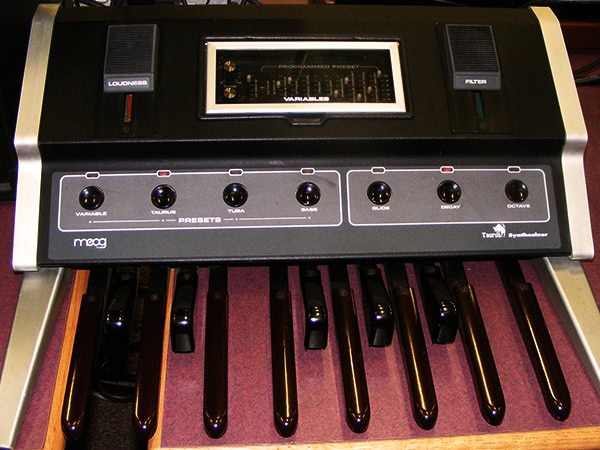
First introduced in the 1970s, the Taurus bass pedals were designed to let keyboard players trigger deep analog bass notes with their feet — and the result became legendary.
That unmistakable sound was huge, dark, and physically present in a way few synths could replicate.
The Minitaur was essentially Moog’s modern reinterpretation of that concept: taking the spirit of the Taurus bass sound and translating it into a compact desktop monosynth built for contemporary studios.
Rather than aiming to be a do-everything synthesizer, the Minitaur was designed with a very specific mission: deliver authentic Moog low-end.
The legendary status of the Taurus wasn’t built on specifications alone — it was built on records.
The instrument became closely associated with progressive rock acts such as Rush, Genesis, and Yes, where its enormous analog low-end became part of each band’s sonic identity. That unmistakable “wall of bass” character remains one of the key reasons the Moog Minitaur still appeals to producers decades later.
The Moog Minitaur in Detail
The Moog Minitaur was never designed to be a do-it-all monosynth – and that focused philosophy is exactly what makes it appealing. Inspired by the legendary Taurus bass pedals, Moog built the Minitaur around one clear purpose: delivering authentic analog Moog low end in a compact desktop format for modern studios.
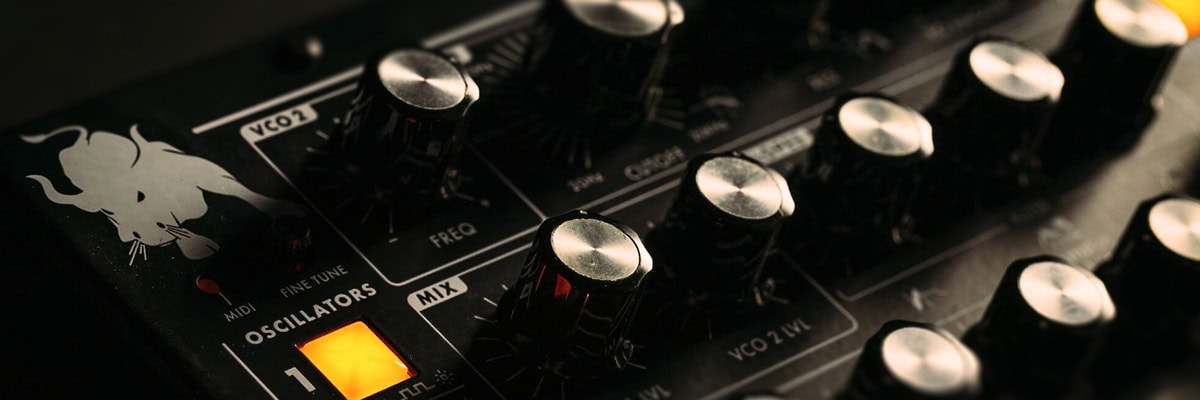
At its core, the Minitaur features two analog oscillators, Moog’s unmistakable 24 dB ladder filter, dedicated envelope controls, and a deliberately hands-on interface that encourages immediate sound shaping rather than menu diving. Its sound is exactly what many producers expect from a Moog bass synthesizer: thick, warm, punchy, and especially convincing in the lower registers where its Taurus heritage becomes most obvious.

Unlike broader modern monosynths that try to cover every possible use case, the Minitaur embraces specialization. It excels at deep basses, driving analog sequences, and raw low-end textures without unnecessary complexity.
That said, the Minitaur is more flexible than its bass-focused reputation might suggest. While the original concept intentionally limited the playable note range to stay faithful to the Taurus idea, later firmware updates significantly expanded its pitch range, making melodic use far more practical than early impressions suggested.
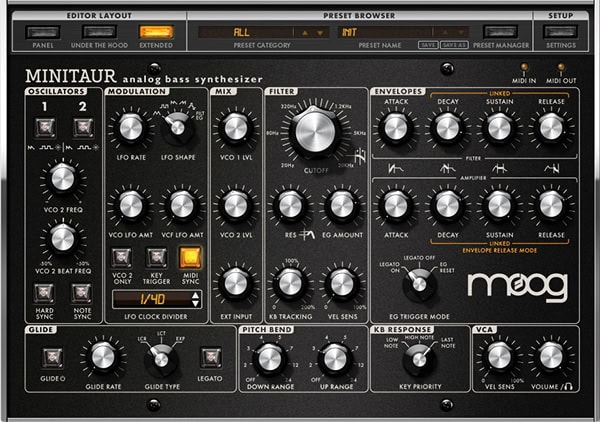
Another often overlooked advantage is Moog’s free editor software, which unlocks deeper access to parameters that are not directly available from the hardware panel itself. This creates a nice hybrid workflow: immediate analog hands-on control when you want tactile sound design, and deeper patch editing directly from the computer when more detailed adjustments are needed.
For studio users, connectivity remains practical even by modern standards, with MIDI, USB, and CV integration making the Minitaur easy to integrate into DAW-based, hardware, or hybrid setups.
The editor software can be download here:
moogmusic.com/downloads
There are also a few practical ownership details worth mentioning. Moog even released a less common white version of the Minitaur, which has become a bit of a curiosity among collectors, and optional rack ears were available for users wanting to integrate the synth into traditional 19-inch rack setups.
Of course, no hardware is perfect. One small but surprisingly noticeable omission is the lack of a dedicated power switch — meaning the unit needs to be powered on and off via the external power connection instead. It’s hardly a dealbreaker, but for many users (myself included), it remains one of those small quality-of-life details that feels strangely absent.
Overall, the Moog Minitaur remains one of the most focused and characterful analog bass synths Moog has produced — especially for producers specifically chasing authentic Taurus-inspired low end rather than maximum feature count.
The Moog Sirin... A More Flexible Alternative?
At first glance, the Moog Sirin may look like little more than a cosmetic variation of the Minitaur — but its purpose goes beyond a simple visual refresh.
Physically, both instruments share the same compact chassis, desktop format, core connectivity, and familiar hands-on workflow. MIDI, USB, CV integration, and the overall control layout remain largely unchanged.
Visually, however, the Sirin has a noticeably different character. While the Minitaur feels dark, rugged, and almost aggressive, the Sirin’s silver finish gives it a more refined and modern appearance — despite being built on essentially the same hardware platform.
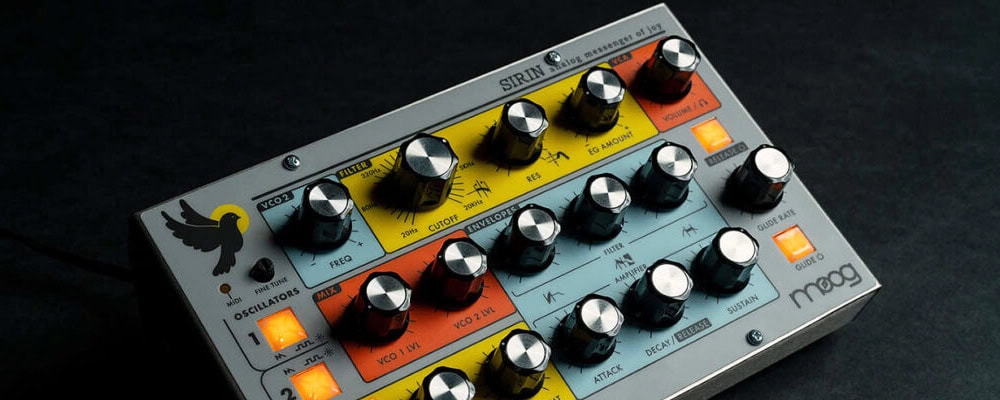
The real difference lies in its musical intent. Where the Moog Minitaur was clearly conceived as a bass-focused instrument inspired by the Taurus legacy, the Sirin takes that same analog architecture and opens it up for broader use. Rather than being centered almost entirely around low-end performance, the Sirin was designed to operate far more comfortably across a wider pitch range, making it better suited not only for bass, but also leads, melodic sequences, arpeggios, and more expressive monophonic parts.
Under the hood, the familiar Moog DNA remains fully intact: dual analog oscillators, the classic ladder filter, and the same immediate tactile workflow that makes the Minitaur so enjoyable to use.
Like the Minitaur, deeper editing is also possible through Moog’s free software editor, giving access to additional parameters beyond the hardware panel and enabling the same hybrid hardware/software workflow. In many ways, the Sirin can be seen as the less specialized interpretation of the Minitaur concept — retaining the same analog foundation, but with a noticeably broader musical range.
Minitaur vs Sirin: Which Is the Better Choice?
On paper, the Moog Minitaur and Moog Sirin appear to be extremely close relatives — and technically, they are.
Both share the same compact hardware format, similar analog foundations, hands-on workflow, and familiar Moog character. But in practical use, their intended purpose feels noticeably different.
If your primary goal is chasing that unmistakable classic Moog bass sound, the answer becomes surprisingly clear: the Moog Minitaur is simply the more logical choice.
That was exactly its purpose from the beginning. The Minitaur was designed as a modern desktop interpretation of the Taurus concept — focused, direct, and unapologetically centered around deep analog low-end performance. If someone searches for a dedicated Moog bass synthesizer, this is precisely the kind of instrument they are usually looking for.
The Sirin, while undeniably appealing, moves away from that specialization. Its broader pitch range and more flexible voicing make it a more versatile monosynth, but arguably less focused on the exact thing that makes the Minitaur so compelling in the first place: authentic Taurus-inspired bass character.
Price also changes the equation considerably.
When originally released, the Minitaur could occasionally be found for a little over €400, making it an exceptionally attractive entry point into real Moog analog hardware. Today, current retail pricing sits closer to €679, which is admittedly a significant jump.
Still, even at modern pricing, the Minitaur remains relatively attainable — especially compared to current Sirin market pricing.
Because the Sirin was produced in much smaller numbers, it was already positioned at a higher price point from the start. In today’s used market, prices commonly land somewhere between €900 and €1400, depending on condition and seller expectations. By comparison, used Moog Minitaur units can still often be found in the €400–500 range, making the value proposition much easier to justify.
That raises an important question:
If melodic flexibility is your real priority, does the Sirin actually make the most sense?
For many buyers, the answer may actually be no. If your goal is classic Moog analog character but with far stronger melodic capabilities, stepping up to something like the Moog Grandmother makes considerably more sense than paying collector pricing for a Sirin. And for more budget-conscious buyers, the newer Moog Messenger arguably offers an even more practical route into modern Moog hardware.
That ultimately leaves the Sirin in a slightly unusual position: desirable, rare, and undeniably cool — but harder to justify as the most rational purchase.
For pure Moog bass, the Minitaur remains the best choice. Available on Moogmusic.com (and all retailers)
Summarized
For me, it’s actually quite clear: the Minitaur is the way to go for that authentic Moog bass sound.
By the way, there’s also a rarer “White Edition”—you might find one on the used market if you’re lucky, though it will certainly come with a price tag to match. There’s also a rack-ear set available for mounting the Minitaur in 19-inch racks, in case the compact desktop form factor doesn’t quite appeal to you.
Personally, I find the Minitaur has only one drawback (aside from the significant price increase over time): the lack of a power switch. Otherwise, it’s a top-notch bass synthesizer. The fact that a free editor plugin is available is also a very welcome bonus for a hardware synth these days.
Possible alternatives
Moog Mariana VST synth
Moog Mariana is worth a look. Unlike the Minitaur or Sirin, it is a software instrument rather than analog hardware, but its strong focus on Moog-style bass sounds makes it a compelling modern alternative. For producers working primarily in the DAW, Mariana delivers much of that familiar Moog character while adding the flexibility and convenience of a software workflow. But it can be heavy on the CPU.
More info: Moogmusic.com
Dreadbox Hades
The Dreadbox Hades is also worth considering. It offers fewer features than the Minitaur, lacks a software editor, and has a somewhat simpler architecture, but delivers a powerful analog bass sound with its own distinct character. While less “Moog-like” in its overall sound, the Hades remains an appealing option for producers who value simplicity. And it`s price tag is also quite nice.
More info: Dreadbox-fx.com
And of course – even if some people dislike hearing or reading this—Behringer hardware synths could also be an option, since some of them are closely modeled after Moog synths. For example… the Toro, System 15, or, of course, the Model D. In principle, there are currently five synths available that are essentially Moog clones.
I hope this article has been helpful to anyone who was unsure whether the Moog Minitaur, the Moog Sirin, or something else entirely would be the best choice as a workhorse for analog basslines. Cheers!