The History of Drum Machines - a brief overview
Most of you probably think that drum machines are completely normal and self-evident in today’s music production. But in the past, these were absolute rarities, sometimes technical pioneers, or for a long time they didn’t even really exist for the majority of musicians. So let’s take a quick, easy-to-understand look at the history of drum machines, and some of the things that will surely surprise you!
The ancient origin...
Rhytmicon
The history of drum machines begins much earlier than the most famous machines of them would suggest. The first drum machine in the world dates back to 1931 – would you have thought that? Just for comparison, the first pocket calculator (“Cal Tech”) came onto the market in 1967. To be precise, it was an automated drum machine called the Rhythmicon. Developed by Lèon Theremin in collaboration with the composer Henry Cowell, it was the first device that could generate complex rhythmic patterns.
The first steps...
Wurlitzer Sideman
The first truly commercially available drum machine was the Wurlitzer Sideman, which was produced in 1959. Different rhythms could be generated using electromechanical technology. A rotating arm touched contacts, which in turn closed an electrical circuit, which then triggered a drum sound.
Of course, the Wurlitzer Sideman looks completely different from the drum machines we know today, but it was also the early years of modern electronics and circuits. When you consider this, it is all the more astonishing what was achieved with the Sideman back then.
The early beginnings...
Rhythm Ace FR-1
The Ace Tone FR-1 drum machine, also known as the “Rhythm Ace FR-1“, was one of the first truly commercially successful (and portable) drum machines of the time, released in 1967. The forefather, so to speak, in the history of drum machines as we know them today.
The Ace FR-1 was also one of the first transistor-based rhythm machines, developed by Ikutaro Kakehashi, who later became the founder of Roland Music.
In the early years, the customers of this drum machine were primarily organ players, small bands, and solo artists. The concept of synthetically generated drum sounds and easy useability of the Rhythm Ace had a significant influence on the later models from Ace Tone and Roland.
Roland CR-78
In 1978, the first “typical drum machine” as we know it appeared on stage – the Roland CR-78. It was the first machine that allowed users to program their own rhythms. A milestone for the time. The unique sound of the CR-78 also made it famous and can be found in many iconic songs of the 80s and 90s. Some of the best-known examples are Phil Collins – “In the Air Tonight”, Blonies – “Heart of Glass” and Gary Numan – “Cars”.
The Roland CR-78 also offered something special for the time: it could be synchronized with other devices, which made working in studios and various setups much easier. The combination of good usability, unique sound, and innovative functions gave the Roland CR-78 the legendary status it has today. The pioneer in the early years of electronic music.
The golden era of drum machines...
Roland TR-808
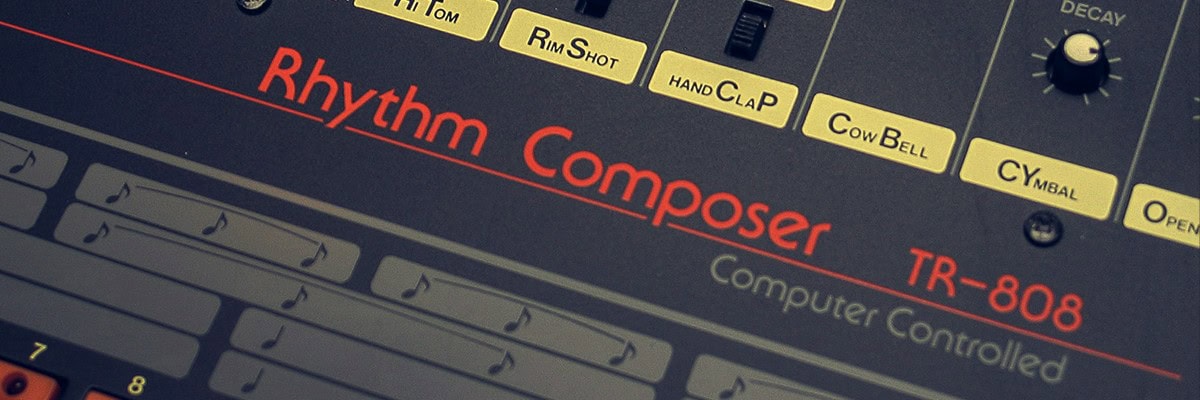
The year 1980 marked the beginning of the golden age of drum machines, a decade that produced the most famous of them. The Roland TR-808 came onto the market in 1980 and is probably the most famous drum machine in history – even today it is still used extensively. Deep house, minimal techno, modern pop and rap music, all the way to trap with the distinctive boomy 808 sub kick basslines.
But the Roland TR-808 actually had a difficult start. It was not very successful commercially at first. To make matters worse, the end of production of crucial semiconductors for the circuit also led to an early end to production. The remaining units were offered at greatly reduced prices. This made the TR-808 more accessible to many musicians and producers. Around 12,000 units were produced. One of the most famous songs that the TR-808 has influenced is “Sexual Healing” by Mariva Gaye. Alongside many top artists of modern times, such as Outkast, Kanye West and many others, the drum sounds of the 808 can be found in many, many songs.
Oberheim DMX
Just one year later, another drum machine, the Oberheim DMX, entered the scene, but it also provided completely new approaches and innovations. Developed by none other than Tom Oberheim, who was already responsible for many innovative synthesizers. In contrast to the Roland TR-808 or its predecessors, the sounds of the Oberheim DMX were not generated by analog synthesis circuits, but were digital samples. Drum sounds recorded in 8-bit on EPROMs – groundbreaking for the time. And there was also a built-in sequencer that could store up to 100 patterns.
Due to the ability to replace the EPROM chips and thus the sounds, the DMX became an extremely popular machine valued for its reliability, which earned its recognition in countless top hits. Among others, Madonna – “Holiday”, New Order – “Blue Monday”, and many, many hip hop tracks.
While the 808 was the pioneer of analog drum machines, the DMX was the first digital rhythm device in the history of drum machines. And thus also, to a certain extent, the starting point for later products such as samplers.
Roland TR-909
Three years after the 808, another drum machine, the Roland TR-909, came onto the market and continues to have a massive influence on music to this day. Based largely on analog circuits, partly on samples, with a very user-friendly “hands-on” layout and a step sequencer that could save patterns, the TR-909 became a key stylistic tool in today’s house and techno music. It was also the first Roland drum machine using the new MIDI protocol. There is hardly a techno track that doesn’t contain sounds from the 909.
LinnDrum
Another icon from the golden era is the LinnDrum (LM-2) by the developer Roger Linn. The successor to the LM-1 shaped a whole era of music with its characteristic sound and innovative features.
Known for its warm and punchy sound, which also had a slightly rough touch thanks to the use of EPROMs with 8-bit samples of real drum sounds, it became the preferred drum machine of many of the top stars of the time in the 90s. Depeche Mode, Madonna, Michael Jackson, Peter Gabriel, and many more – just to name a few.
The digital revolution...
E-MU SP-12
In 1985, the history of drum machines experienced a new development. The EMU SP-12 was a digital sampling drum machine that came onto the market and had a significant influence on the future development of drum tools.
Unlike previous digital machines, the SP-12 did not simply play recorded samples from EPROM chips, but instead allowed users to record and use their own sounds. With the 12-bit format and 27.5 kHz sampling frequency, sampled sounds also had a certain lofi touch that people still try to emulate today.
The EMU SP-12 and its sampling concept (which was improved a short time later by its successor, the “SP-1200”) changed music production and ushered in a new era of creativity and digitalization. Nowadays, sampling is indispensable, and thanks to innovative devices such as the SP-12, we can let our creativity run free every day using this feature.
Akai MPC60
After the demise of Linn Electronics (LinnDrum LM-2), Roger Linn started a collaboration with Akai after the development of the Linn9000 drum machine failed due to many problems and bugs in the OS. The result was a drum machine/sampler that became the ultimate standard for hip-hop.
The legendary MPC60 from 1988 was essentially the first real drum sampler and sequencer in one. This created a completely new production platform – for everyday studio use but especially for live sessions. This meant that all kinds of samples, not just drums but also vocals, for example, could be used directly in sequences and tracks could be produced almost live. At the same time, the usefulness of other classic analog drum synths and machines was increased, as the MPC60 allowed both to work together in a positive way.
Elektron Machinedrum
In 2001, the concept of digital drum machines was taken to a new level with the Machinedrum from the Swedish developer Elektron.
This digital drum machine was extremely powerful, flexible to handle and also very popular in almost all genres thanks to its own slightly distinctive sound. From house, and techno to hip-hop, the Machinedrum still has many fans today. Thanks to its high-quality workmanship, a completely coherent concept in the workflow, features, and sound library, the Machinedrum is now considered a kind of milestone and the origin of all modern digital drum tools.
Drum machines today...
Nowadays, the spectrum of drum machines is very broad. Many are based on their predecessors from the past, such as Akai MPC Live II, Roland TR-8S, and also Elektron Analog Rytm MkII. At the same time, there are very popular specialists in many niches of workflow and feature-set. A good example of this is the Korg Volca Drum, and also Novation Circuit Rhyhm. Classic analog drum machines are almost nonexistent anymore, much more hybrid approaches like the Erica Synth Perkons HD-01, or pure analog drum synths like the Moog DFAM.
The increased use of all digital features is offered by Native Instruments Maschine MkIII, with extensive sequencer, VST host function, NKS support, and much more – making the enormous leap in development from an MPC60 to today very clearly visible.
What the future holds for drum machines is of course difficult to predict, but one thing has been certain for several years – pure analog drum machines like the TR-808 will certainly be very rare, more likely to be niche or clones of previous ones. Therefore, development will probably go even more in the digital direction with more focus on workflow, sound design, and certainly also the use of AI in sample management or sound processing.
I hope this short overview of the history of drum machines and their development up to today’s models was interesting for some and fun to read and watch. Cheers…